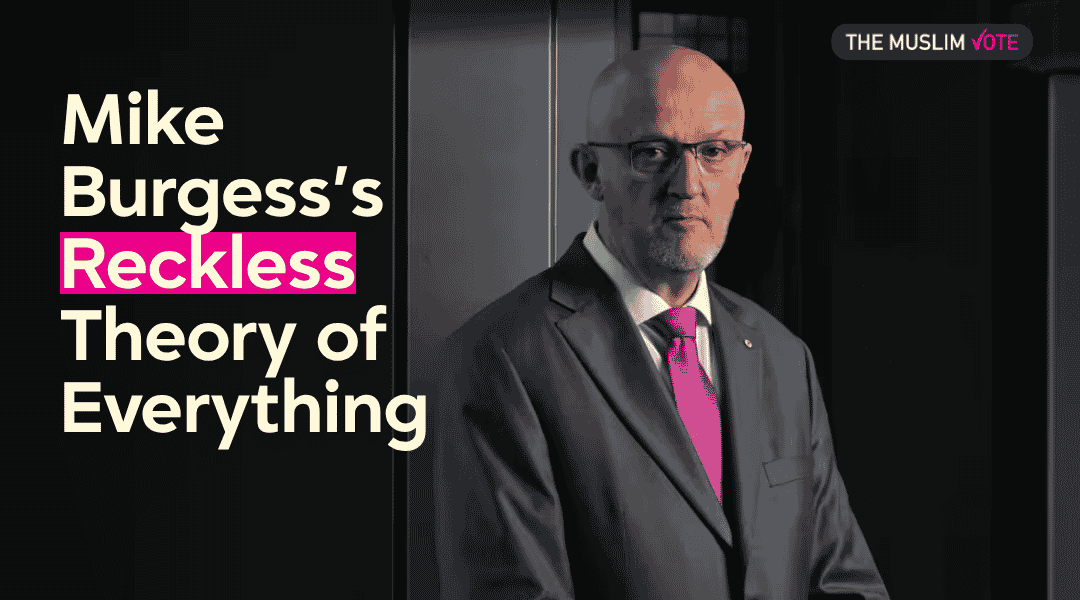
Mike Burgess’s Reckless Theory of Everything

Dr Wesam Charkawi completed a PhD in Countering Violent Extremism at Western Sydney University
Reckless, academically clumsy, and dangerous are the words that come to mind following the speech of ASIO's boss, Mike Burgess, at his annual threat assessment 2026.
The grand unifying theory that should not be taken seriously
Australia’s security debate is being invited to accept a reckless analytical fraud: that antisemitism now explains almost every violent extremist current worth naming. Neo-Nazis, foreign states, protest-linked vandals, issue-motivated actors, anarchists, revolutionary groups and terrorists are being marched into the same analytical room and presented as evidence of one grand unifying threat. It sounds expansive, but is reckless and lazy. A serious assessment would separate who acted, who directed, what was intended, why a target was chosen, what harm followed and which legal threshold was met. This framing does the reverse and piles categories on top of one another, mistakes accumulation for proof, and then calls the resulting confusion a sophisticated account of a degrading security environment.
Turning antisemitism into an all-purpose explanation
Burgess inflates antisemitism into a grand theory of violent extremism. He does this explicitly, claiming that hatred of Jews is something “virtually all” violent extremist cohorts have in common, before naming neo-Nazis, “Islamic extremism,” issue-motivated extremists, nation states, anarchists, revolutionary groups and far-left activists as part of the same antisemitism-centred security field. In a space where scholars have debated radicalisation, mobilisation and violent extremism for decades, Burgess appears to have discovered a wonderfully simple answer: put every difficult category into the same room, point to antisemitism, and call the gathering complexity. That is academically wrong and intellectually lazy because it turns antisemitism into an all-purpose explanatory device. Burgess does not establish causation, examine root causes, distinguish ideology from mobilisation, or conduct pathway analysis. He names categories, piles them together, and treats the pile as proof.
Burgess then stacks criminal arson, foreign interference, communal violence, politically motivated violence and state-sponsored terrorism as though piling labels on an incident proves analytical sophistication. It does not. Each label answers a different question and requires a different threshold. Criminal arson concerns conduct. Foreign interference concerns direction. Communal violence concerns impact. Politically motivated violence concerns purpose. Terrorism requires its own legal elements. Burgess compresses them into one chain and calls the compression complexity.
Policy danger
If antisemitism becomes the master frame for violent extremism, institutions will start looking for antisemitism everywhere instead of examining actual pathways into violence: grievance, isolation, family rupture, foreign policy, mental deterioration, group dynamics and opportunity. A distorted diagnosis produces distorted prevention. It widens the security net, invites surveillance of political advocacy, and misses the real drivers of harm.
Burgess cites "Islamic extremism"
Burgess uses the phrase "Islamic extremism" in the same sentence as antisemitism and violent extremism. The phrase is not neutral. It fuses the word Islam with extremism and invites the reader to treat Islam as the ideological source of violence. A half-decent academic account would specify the actor, movement, doctrine, network, claim, context and evidence. The problem is compounded by the next statement. The words, “Islamic extremism is antisemitic”, are not an analysis; it is a category claim that risks reproducing the very identity-based generalisation scholarship warns against.
The second sleight of hand is just as serious: extremism is allowed to impersonate violent extremism. The literature of violent extremism holds that extremist belief, sharp political dissent, religious conservatism, ideological rigidity, grievance, offensive speech and violent mobilisation are not the same phenomenon. Burgess assumes that extremism is a proxy for violent extremism, which is not correct. For example, a person can be anti-establishment but will never commit violence. In fact, non-violence is the norm. McCauley’s (2022) commentary confirms that the ABC model, like his Two Pyramids model, is intended to correct the mistaken belief that extremist ideas automatically lead to violent extremism. Sageman (2017) argued that few individuals act on extremist ideas, aligning with Horgan’s (2011) argument that a cognitive radical is not a precursor to terrorism.
Research failure
Burgess displays ignorance of the decades-long research in this field, lumping categories together, stating ill-defined categories, and suggesting a supreme master theory of violent extremism that revolves around antisemitism. Burgess’s formulation takes a word that may describe opinion and sets it beside terrorism as though the journey from belief to violence has already been proven. That is not intelligence analysis; it is conceptual smuggling. The danger is that politicians, media outlets and advocacy groups will treat this official speech as authority, repeating the category error until it becomes policy common sense.
Burgess names antisemitism as a national security threat with prosecutorial force, names Iran as a foreign actor with operational detail, names “far-left activists” as perpetrators of vandalism and arson, and names “issue-motivated extremists” as part of the threat environment. Yet the reality at the centre of the public anger based on mass civilian killings is not worth a mention. Palestine is not treated as a people under occupation, Gaza is not treated as a place of mass civilian killings, and Israel is not treated as an entity deliberately targeting and killing Palestinian children, resulting in genocide, crimes against humanity and war crimes in Gaza (UNHR).
"Issue-motivated extremism"
The phrase “issue-motivated extremism” used by Mike Burgess reveals how easily Palestine advocacy, anti-genocide mobilisation and justice-based mobilisation can be moved into a security frame without being answered on its merits. The framing explicitly implies the illegitimacy of any legitimate issue when it concerns Israel. By saying issue-motivated extremists “can be antisemitic,” the passage opens the door to treating entire advocacy fields as suspect. It securitises political anger without honestly naming any issue. Gaza does not exist in the abstract. The Israeli military violence is real, the occupation and genocide are real (BBC, June, 2026), and Australia’s alignment with Israel is real. It is the role of companies, institutions and political actors supporting and enabling that violence. Burgess does not engage any of this as political substance. He places it under the administrative label of “issue-motivated” and then positions the people advocating for justice as extremists rather than conscientious. That is how legitimate issues are made available for security treatment without ever being answered on their merits.
Misdiagnosing distrust
Burgess’s speech exposes a deeper failure in how the security state understands distrust. He identifies eroding trust in institutions as part of the degraded security environment, but treats that distrust as though it descends from social media, polarisation and inflammatory rhetoric. That account is convenient because it keeps the state outside the causal frame. It does not ask why communities distrust law enforcement, intelligence agencies or government in the first place. It does not confront the documented history of disproportionate counter-terrorism policing, Muslim-focused P/CVE programs, securitised engagement, political rhetoric, foreign policy double standards, surveillance focus, media demonisation and the repeated treatment of Muslim and Palestinian grief as risk.
Distrust is not a mood; it is an institutional consequence. Communities do not withdraw trust because they have been tricked by the internet into suspicion. They withdraw trust when government agencies are not serious about addressing root causes and when they ask for cooperation while simultaneously framing them as the "other", when Palestine advocacy is cast as extremist language, and when national security officials describe social fracture without examining the role of the security apparatus in producing it. Burgess speaks as though distrust is an environmental hazard. In reality, the state manufactured the conditions he now laments.
The result is a circular security logic. Institutions produce suspicion through overreach, selective language, securitised engagement and partisan threat framing; communities then distrust those institutions; that distrust is then cited as evidence of a more volatile and degraded environment requiring further security attention. Burgess does not break that cycle; he restates it with better lighting. A national security chief who speaks about trust without confronting the reasons trust has collapsed is not diagnosing the problem. He is protecting the institution from the evidence.
A partisan security narrative dressed as complexity
The danger in Burgess’s speech is that antisemitism is inflated, Islam is implicated, Palestine is emptied of meaning, legitimate protest is framed with suspicion, and distrust is blamed on the public rather than examined as an institutional product. That is not sober national security analysis; it is a partisan security narrative dressed in the language of complexity.