Queensland criminalises specific chants used to call for an end to the Gaza genocide. The “reasonable excuse” defence is no safeguard
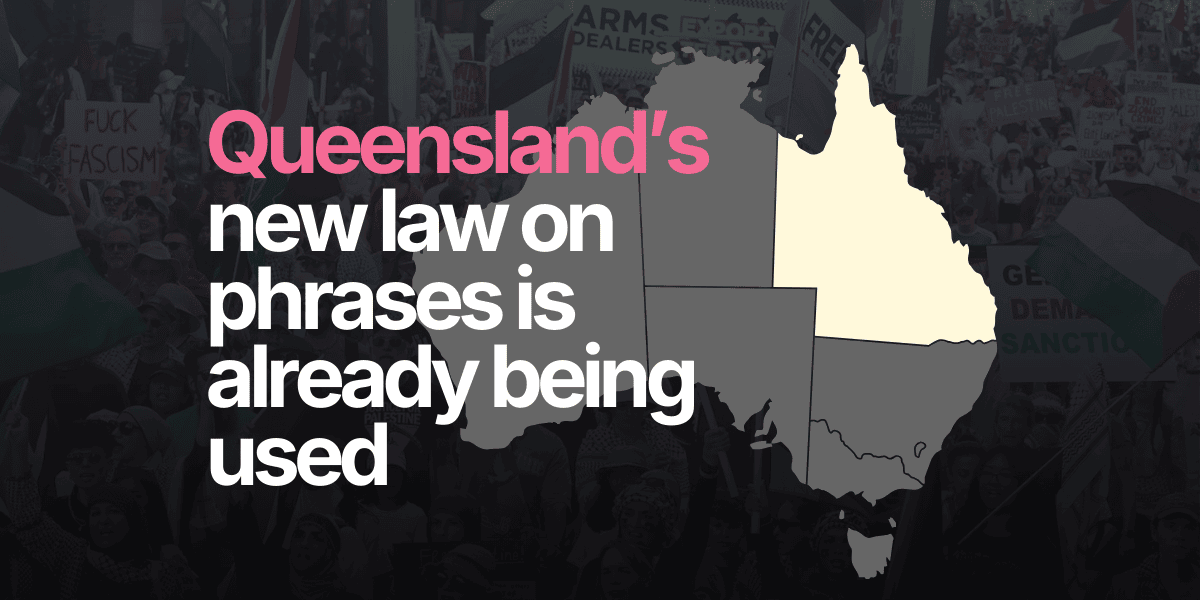
Queensland has now passed the Fighting Antisemitism and Keeping Guns out of the Hands of Terrorists and Criminals Amendment Act 2026. Buried inside a broader package of firearms and policing changes is a new criminal offence targeting the public recital, distribution, publication or display of certain “prohibited expressions.”
The two expressions fixed directly into the law are “from the river to the sea” and “globalise the intifada.”
The basic offence is broad
A person commits an offence if they publicly recite, distribute, publish or display one of those expressions in a way that might reasonably be expected to cause a member of the public to feel menaced, harassed or offended. The maximum penalty is 2 years' imprisonment.
Police have already acted on it. On the very day the law commenced, arrests were made at a pro-Palestine protest outside Queensland Parliament.
That tells you everything you need to know about where this law is headed.
The first thing to be aware of is that there is no real protection for citizens. While the Queensland government technically incorporated a reasonable excuse defence into the law (for example, for a genuine artistic, religious, or educational purpose), a defence is what you try to raise after police have already stopped you, questioned you, arrested you, charged you, dragged you through court, and marked your name with suspicion.
A defence does not stop police intervention. It does not stop legal costs. It does not stop the chilling effect that lands long before any conviction.
The second thing to understand is that the burden will not fall equally across society. This law will not be applied neutrally to all citizens. It will fall most heavily on those most likely to use these expressions in public: Palestinian protesters, Muslim youth activists, student organisers, community speakers, social media campaigners, and those mobilising around Gaza.
Police "interpretation"
It means the ordinary person now has to guess, in real time, whether police will treat their speech as genuine political expression, genuine public-interest advocacy, or as something criminal. A Muslim teenager at a rally, a university student holding a sign, or a volunteer leading a chant may now have to prove later that their politics were genuine, their purpose was in the public interest, and their conduct was reasonable. This is legal intimidation.
And the uncertainty is intentionally built into the law, leaving the key terms broad. What counts as “public interest”? What is “reasonable in the circumstances”? What will police treat as “offended”? What kind of audience reaction will be enough? These are not bright lines. These are open fields of discretion, and discretion is never experienced evenly by all communities.
Directly tied to Palestine advocacy
The Queensland government may say this law is about antisemitism, but the most visible speech offence in it is a prohibition on phrases tied directly to Palestine advocacy. This means Muslim and pro-Palestine political expression is now being drawn into a legal framework publicly sold under the language of hate, extremism and threat. Even before a court says anything, the structure of the law itself encourages the public to read opposition to genocide and solidarity with Palestine through the language of antisemitism, while collapsing the distinction between Zionism and Jews.
That stigma does real work
It affects how police respond on the street. It affects how the media reports arrests. It affects how schools, universities and employers interpret participation. It affects how Muslim political speech is heard by the wider public. And it pushes community organisers into a new posture of caution, where they must warn crowds not to say certain phrases, not to hold certain signs, and not to expose themselves to arrest.
That is how protest is narrowed without needing a mass wave of convictions. You just need to make enough examples, create enough uncertainty, and force enough people to ask themselves whether it is worth the risk. That is what this law does.
What TMV is raising here is not just a process complaint. It is a legitimacy complaint.
TMV is saying that this law was rushed through without meaningful engagement with the very communities most likely to be affected by it, and that this matters because laws touching protest, religion, political speech and policing do not operate neutrally once they hit the ground. The Queensland committee process records that the Ethnic Communities Council of Queensland said the bill lacked meaningful consultation and that reforms of this magnitude should be developed with multicultural and faith communities to assess unintended impacts. The amendment notes also state that no consultation was undertaken on the final amendments because of their “remedial nature.”
When governments rush laws through, shut communities out, and hand police more power over political speech, people do not see protection. They see power being used on them, not with them. That is how mistrust takes hold.
The Muslim Vote is a Future Investment in Community
Donating to The Muslim Vote is not a donation to a moment; it is an investment in long-term political capacity. TMV builds infrastructure, strategy, research, and organised community power that outlasts election cycles. Your support strengthens the systems that convert collective concern into lasting political consequence.
Donate nowFollow us on Instagram