Selective Climate Control: "Turn the temperature down", Tony Burke says
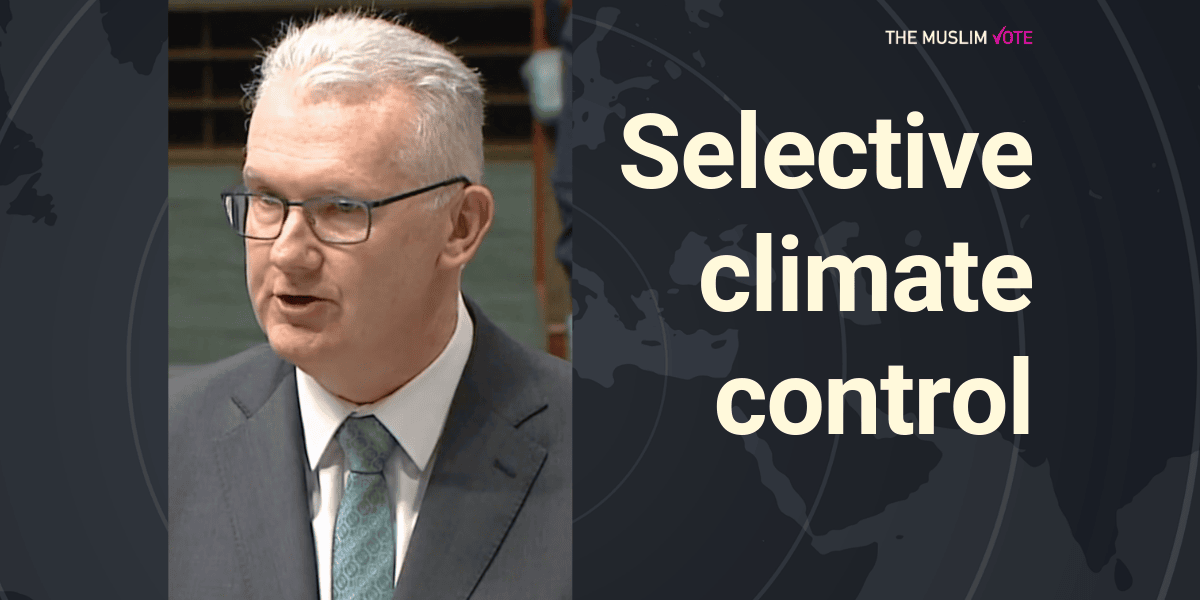
On Tuesday, Tony Burke, the Minister for Home Affairs, stood at the dispatch box like a man convinced of his own moral framing. He spoke in declarative tones, invoking national security and civic responsibility as though the ground beneath him were uncontested, "Every elected official who claims to care about national security has a responsibility to turn the temperature down. Every Australian Muslim, just like every other Australian, has a right to be safe and feel safe."
Some reflections on his statement are warranted.
When Tony Burke is part of the machine apparatus that inflicted the most Islamophobic laws in Australia under his specific authority, the credibility of that appeal must be examined against his record. Under his portfolio, Tony Burke could have cancelled the visa of Isaac Herzog to Australia on character grounds, a man who the United Nations said incited genocide. He's openly admitted to cancelling 7000 Palestinian visas. He criticised Hannah Thomas after being punched by the police at a protest, saying, "No one is above the law." The police officer has since been charged. In 2024, Tony introduced mandatory minimum sentences for hate crimes, a marked departure from longstanding Labor positioning, citing the explosives caravan incident as justification, which we later learned was a hoax, yet Tony Burke had prior knowledge that it was a set-up, after a briefing by the Australian Federal Police (AFP). That sequence alone demands accountability.
 TMV Australia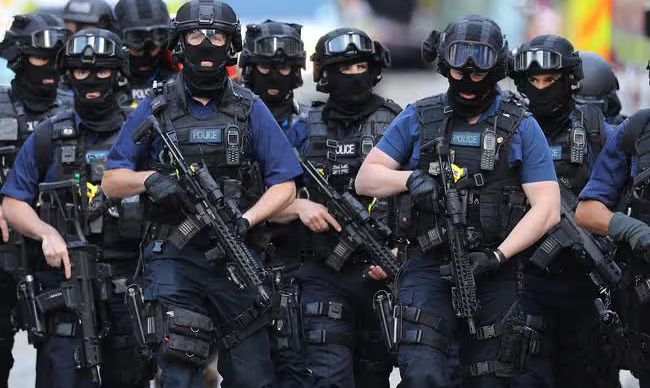
Even Dr Jamal Rifi, who openly supported Tony Burke at the 2025 Federal election, was left hung out to dry when the story of the 35 women and children trapped in Syria was made public. Dr Rifi is on the record saying, "I thought the chances with Labor are better. I do know now that I miscalculated." Political expediency is not invisible, and communities can see when a politician aligns with certain figures or groups when it is useful, and distances themselves when it is no longer advantageous. Spare Australia from the violin; the melody of moderation sounds hollow when played by those who tuned the instrument.
Decades of scrutiny and pressure
Tony Burkes speaks of lowering the temperature, and for Muslims in Australia, the temperature has not been rhetorical theatre. They have lived under political “temperature” in Australia for decades, through disproportionate policing, expansive surveillance, negative political discourse, and counter-terrorism frameworks that bleed into domestic policies. When the devastation in Gaza intensified, and protesters filled the streets in visible numbers, that public grief was framed as a threat to stability. The same voices that normalised years of securitised policy suddenly discovered a concern for social cohesion, framing lawful demonstrators as a threat and attempting to link their stand with the Bondi shooting.
So let us stop pretending that fear, division, suspicion and hostility emerged spontaneously. They have been shaped by political choices for decades.
In the immediate aftermath of 7 October, the Federal Government illuminated Parliament House (Canberra) in Israeli colours, making a clear and deliberate declaration of alignment. This was a statement of position. Yet as the civilian death toll in Gaza escalated into the hundreds of thousands, there was no equivalent state action, no sanction, and no appetite to formally utter the word genocide. The hierarchy of moral concern was evident in the decision to offer immediate and visible solidarity in one instance, and to manage mass civilian destruction through careful and calibrated language in another. That hierarchy did not remain symbolic; it shaped policy. The refusal to respond proportionately to mass civilian destruction revealed a political threshold for action that Palestinians did not meet.
The atmosphere on the 6th of October
So while the likes of Tony Burke, Albanese, Minns and others repeatedly invoke “social cohesion,” what is really sought is the return to the atmosphere of 6 October, when Palestinian civilians were dying daily with little disruption to domestic political comfort, when there were no mass demonstrations, no sustained public scrutiny, no visible moral friction. Cohesion, in this formulation, is equated with the absence of protest and the containment of outrage.
That understanding is fundamentally flawed.
Social cohesion is not generated by silence or the absence of protest. It emerges from trust in institutions, consistency in the application of principles, and confidence that grievances can be expressed without penalty. Suppressing lawful political expression may reduce visible disagreement, but it does not resolve underlying tensions; it displaces them.
Decades of engagement
Decades of engagement have not prevented legislative escalation. Communities and generations of families (well-intended) participated in electoral politics, built institutions, moderated tone, and navigated the language of loyalty with care. In return, they have watched the expansion of powers justified in the language of order and security. They have watched exceptional measures become normalised. They have watched politicians play their games at the expense of human life. This is the real tragedy.
Perhaps the temperature would be easier to lower if it had not been so selectively managed in the first place. It is always simpler to call for calm from the dispatch box than to account for the sequence of decisions that helped inflame the society. Those who speak most confidently about social cohesion might begin by reflecting on the cohesion of their own record, on the alliances formed, the alliances abandoned, and the vocabulary deployed when it mattered. Dr Rifi learned, as others have, that proximity is not permanence. The rest of the country has learned something too: that lectures on moderation carry little weight when delivered by those who helped script the heat.
Why this matters
This affects every member of the community, not only those directly involved in politics. When a community’s political voice carries no consequence, decisions are made without regard for its concerns, its safety, or its future. Policies that frame Muslim civic participation through suspicion, silence around mass suffering abroad, and dismissive responses to community advocacy do not remain confined to parliamentary debate. They shape how institutions treat ordinary people, how young Muslims are perceived in public life, and how confidently the next generation believes it can participate in the country’s political future. Political agency is therefore not an abstract ambition. It is the condition that determines whether the community is spoken for by others or whether it speaks for itself.
The Muslim Vote’s position was never about helping one party defeat another; it was about ending a cycle of dependency in which Muslim votes are assumed, taken for granted, and therefore ignored. Burke’s statement illustrates the problem directly. Appeals for restraint come easily when political consequences do not exist. Change only begins when those consequences become real. That is why the strategy remains the same: build independent political leverage, organise strategically, and ensure that the community’s voice is felt where it matters most in a democracy, at the ballot box.
 Dr Wesam Charkawi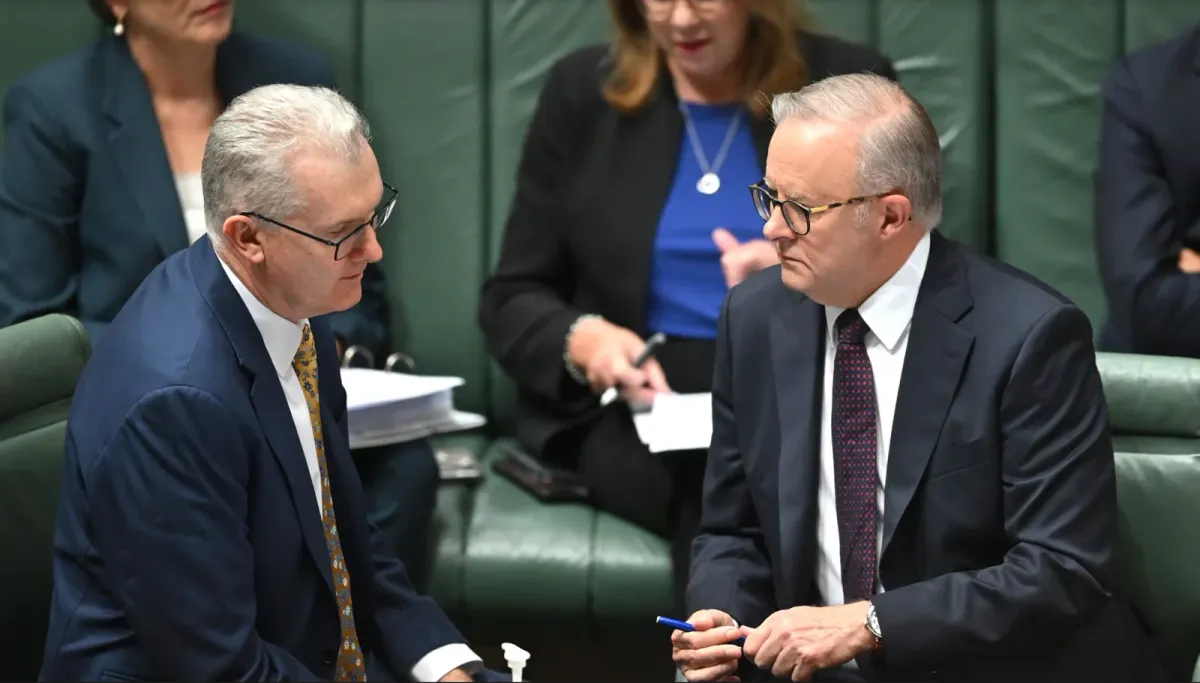
Follow us