What the Ban on Hizb ut-Tahrir Means for Other Organisations in Australia
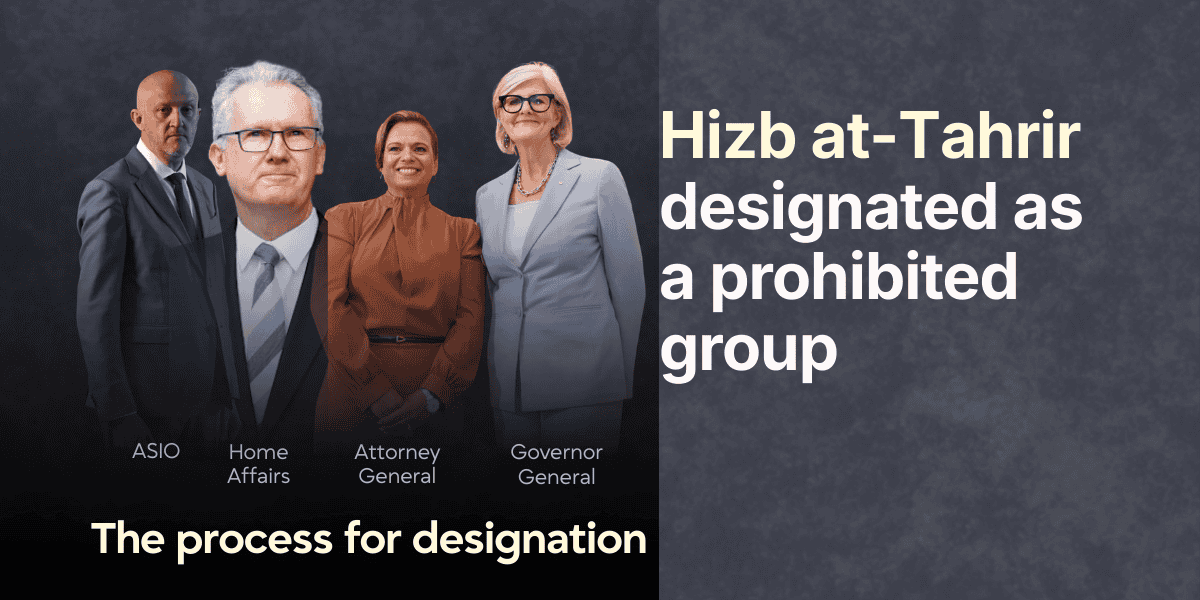
The Australian government has formally listed Hizb ut-Tahrir as a prohibited hate group under the new hate-group laws, making it the first group banned under that framework. The decision changes the legal standard for prohibiting organisations in Australia and expands the government’s power to impose those bans.
Under the new framework, the process begins with written advice from ASIO recommending a listing. The Attorney-General must then give written agreement. After that, the AFP Minister or Home Affairs Minister can recommend the listing, and the Governor-General makes the regulation that formally designates the organisation.
The real question raised by this decision is what that change means for every other organisation operating in Australia.
Government figures have repeatedly acknowledged that Hizb ut-Tahrir had operated within the law since its establishment in Australia. That matters because it makes the starting point clear. At the time, the organisation’s activities were lawful under the rules that already existed. The ban did not come after hidden criminal conduct was uncovered or after new evidence linked the group to violence. It came after the government created a new legal pathway that allows organisations to be prohibited even when they do not meet the standard required for a terrorism ban. Once that is clear, the issue is no longer only Hizb ut-Tahrir. The issue is the new power the government has created to outlaw organisations that had been operating within existing law.
A Lower Threshold for Prohibition
The new hate-group listing framework allows the government to prohibit organisations when authorities conclude that a group promotes hatred, ideological hostility, or forms of radicalisation said to threaten social cohesion. Unlike earlier frameworks used to ban organisations under terrorism law, this type of listing does not require proof that an organisation is preparing violent acts. Prohibition can occur on the basis of the government’s assessment of a group’s ideas, rhetoric, or influence. Once an organisation is listed, offences can apply to directing it, recruiting for it, training with it, or assisting its activities.
Effectively, the question of whether an organisation can be prohibited no longer depends only on evidence that it is connected to violence. It now depends on the government’s judgment about whether the organisation’s ideas or influence contribute to hatred, radicalisation, or social division. Those concepts do not interpret themselves. Ministers and security agencies decide how they are applied and when they justify intervention, and those decisions inevitably develop within the political climate of the time.
Why the Precedent Matters
Governments often introduce powers like this in response to one organisation that has already attracted public anxiety. Hizb ut-Tahrir is the immediate example, but the law does not stop with Hizb ut-Tahrir. Once the government creates a legal mechanism to prohibit an organisation that had previously operated within the law, that mechanism remains available for future use.
That is why the precedent matters. It establishes a new route for banning organisations that the government later decides are unacceptable, but have not crossed the older threshold tied to violence or direct incitement. Every society contains religious movements, nationalist groups, ideological organisations, and activist networks whose views are regarded as disruptive, deeply unpopular or extreme. Once the government lowers the threshold at which prohibition becomes possible, the question is no longer limited to a single organisation. The question becomes which other organisations may later be judged unacceptable under the same power.
How These Powers Can Expand
Communities that already live under disproportionate political and security scrutiny should read this change carefully. Muslim civic organisations, advocacy groups focused on Palestine and international affairs, and movements built around strong ideological commitments already operate in an environment where their language, organising, and public positions are more likely to be interpreted through a national-security frame. For organisations whose politics, faith, or public advocacy already attract official suspicion, this means that disputes over ideas and political messaging can now carry consequences that move well beyond criticism and into prohibition.
The standard for prohibition no longer rests only on evidence of violence or direct incitement, but instead on the government’s judgment.
What this means
The ban on Hizb ut-Tahrir does not stop with Hizb ut-Tahrir. Once the government changes the legal rules for prohibiting organisations, it gives itself a power that remains available long after the first designation is made. That power can be used again, against other organisations, in different political conditions, under the same expanded standard. What this means is straightforward: the boundary between lawful organisation and government prohibition has been moved, and it can be moved again.
The Muslim Vote is a Future Investment in Community
Donating to The Muslim Vote is not a donation to a moment; it is an investment in long-term political capacity. TMV builds infrastructure, strategy, research, and organised community power that outlasts election cycles. Your support strengthens the systems that convert collective concern into lasting political consequence.