Write a Submission to the Royal Commission

This is what we are asking the community to do
The Muslim Vote (TMV) is urging community members to make individual submissions to the Royal Commission on Antisemitism and Social Cohesion and to attend TMV’s workshop on how to prepare those submissions properly. The reason is straightforward.
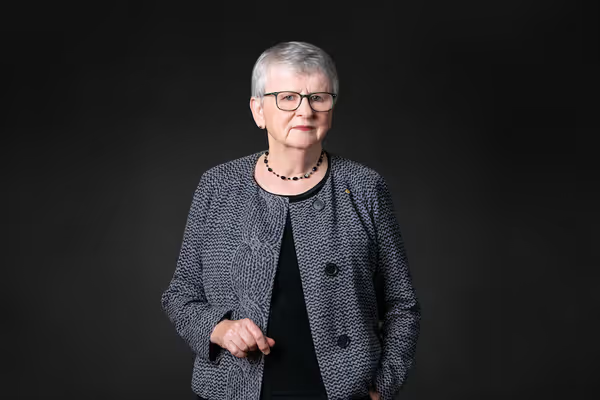
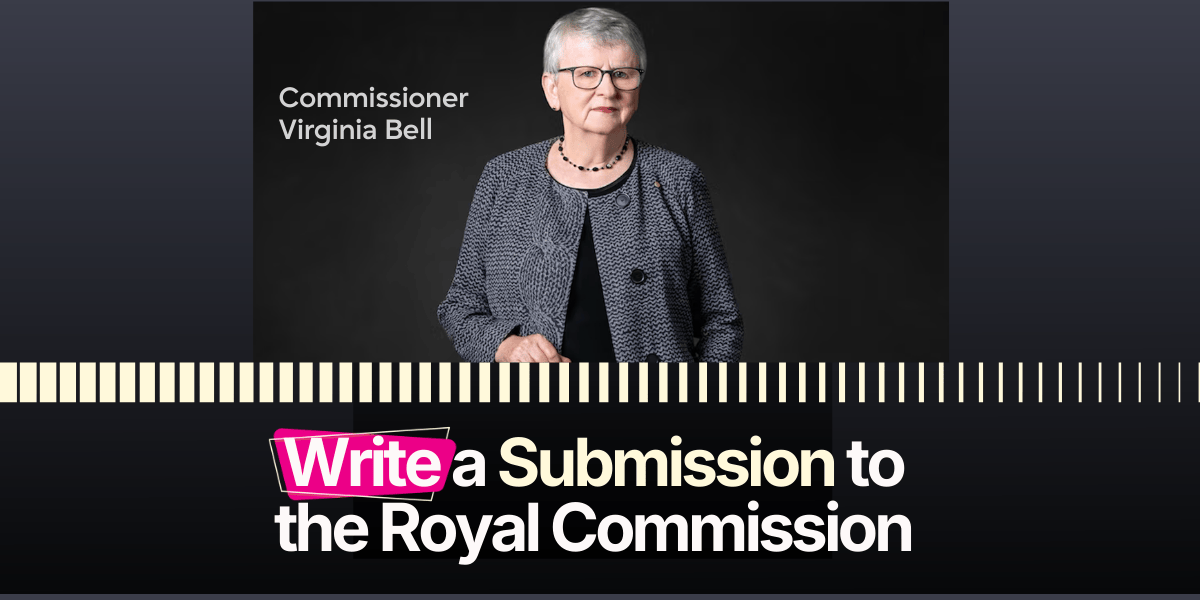
This inquiry will help shape the official record of what this period in Australia is understood to mean, whose experiences are treated as central, and which forms of harm are taken seriously by institutions. Commissioner Virginia Bell has made clear that the Commission’s focus is on antisemitism, but she has also accepted that anti-Palestinian racism and Islamophobia may be considered under the broader question of social cohesion. That opening must be used deliberately and carefully, with submissions grounded in lived experience, because the Commissioner’s recommendations will be based on the information and evidence placed before the Commission. If our community does not put its experiences on the record, the account that informs those recommendations will be built around other people’s versions of what happened to us, what was said about us, and what was done in the name of cohesion, safety and public order.
The record will be built with or without you
Royal Commissions do more than collect stories. They build the official record that governments, institutions, journalists and future inquiries return to when they decide what happened, what counted, and what requires action. The Commission itself says all submissions will be recorded, reviewed and used to inform its work, even though not every person will be contacted or called as a witness. That practical reality should concentrate minds. If Muslim Australians, Palestinians, and those targeted for speaking about Gaza do not write, the record will be thinner where it should be strongest. Details that should shape the national account will be absent because the people who lived them never placed them on paper.
Individual submissions carry weight
A personal submission can explain what happened at work after a social media post, what was said at school or university, how a child was treated, how a mosque member was threatened, how a protester was handled, how a doctor, teacher, or employee was pressured into silence, or how anti-Palestinian abuse was dressed up as public order and social cohesion. Dates, emails, screenshots, meeting notes, disciplinary letters, police interactions, and witness names turn a general complaint into a concrete pattern.
The Commission invites submissions from any person or institution with relevant experience or knowledge. It also allows requests for confidentiality and says that making a submission does not commit a person to giving evidence in public. Those protections matter because they lower the risk for people who want the truth on the record without exposing themselves unnecessarily.
TMV’s workshop is part of the work
A submission only helps if it is clear, specific, and usable. The Commission’s guidance explains that some submissions may be published where permission is given, and that people can request non-publication or confidentiality in appropriate cases. That is why The Muslim Vote is holding a workshop on how to write a submission and what a proper submission looks like. Community members should attend ready to learn how to set out events clearly, what evidence to attach, how to explain harm in plain language, and how to decide whether to identify themselves publicly. This is practical preparation for building a record that cannot be brushed aside as vague, emotional, or second-hand.
When?
Full details about the date and location of the workshop will be announced shortly after Ramadan. Register your name now so you receive the update as soon as it is available.
The window is open until the end of May 2026
The Commission says it will continue to accept submissions until at least the end of May 2026. The window is open, and the community should use it. Make your submission. Attend the workshop. Bring someone else. Put the truth on the record before others decide what this period meant.