Chris Minns Announces New Police Unit with 60 “Multicultural" Liaison Officers
Forget that Chris Minns passed laws knowing the explosives caravan was a hoax. Forget that the NSW Police force assaulted, pepper-sprayed and broke bones, including throwing worshippers out of their prayer, all for protesting against the visit of a man who incited genocide of Palestinians. Forget that gangland shootings are playing out in Sydney suburbs right now. Forget that the Law Enforcement Conduct Commission is investigating Police officers for their conduct on the 9th of February. Forget that a weapons expo with weapons tested against children was welcomed into Sydney under his leadership. Put all of that to one side.
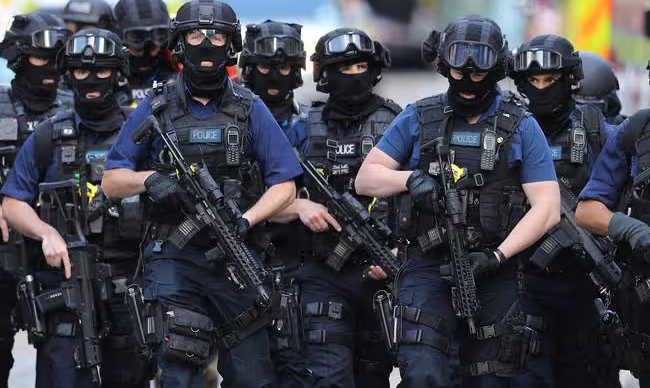
Because now, a new hate task force of 250 heavily armed police is being constructed and will operate 24/7. It will be permanent, dedicated, visible, and armed with long-arm rifles. Deployed around “mass gatherings such as protests and places of worship.”
For our protection, Chris Minns says.
Because what NSW apparently needs, urgently, decisively, without hesitation, is a permanent, armed, rapid response unit with long-arm rifles patrolling protests and places of worship.
Multicultural liaison officers
It has now been confirmed that the government will double the number of multicultural liaison officers from 30 to 60. Not community liaison. Not suburban liaison. Not statewide general engagement. Multicultural liaison. The terminology is deliberate. In Australian bureaucratic language, “multicultural” does not refer to the Anglo mainstream. It refers to communities considered culturally distinct from it. So when the only expanded engagement mechanism is explicitly multicultural, the government is signalling where it believes friction exists, where it believes management is required, and where it believes heightened policing must be buffered by “relationship building.” Anglo Australia is treated as the baseline. Multicultural Australia is treated as a category requiring structured supervision. That distinction is not accidental.
The message writes itself, and the contrast is difficult to ignore: armed patrols on the street, liaison officers for reassurance. The message presented is one of protection. But protection from what? From violence, or from visible political mobilisation? From genuine threats, or from large numbers gathering in dissent?
If this were truly a universal public safety measure, engagement would not be framed through a cultural lens. It would be organised by geography, risk profile, and transparent criteria. Instead, the structure suggests differentiation: one set of communities to be managed through liaison, and another that remains the institutional baseline. Communities can see that distinction, and they understand where they are positioned within it.
There is also an uncomfortable question about representation. Will liaison be disproportionately ethnic, as if trust is something to be outsourced to faces that look familiar, while command and enforcement structures remain untouched?
Anthony Roberts (Shadow Minister for Police and Counter-terrorism) questioned the move, citing resources. NSW Greens MLC Sue Higginson called the announcement an attempt to “misconstrue” political protest as dangerous and extremist, and warned that rapidly deployed armed forces in the community could increase the risk of “violence, harm and death”.
High-risk areas
The ABC reports this new Armed Response Command will patrol “high risk areas, places of worship, major events, and mass gatherings such as protests” and that it will be backed by a 24-hour operations centre for “training, logistics and intelligence”. The NSW Government’s own release frames Operation Shelter’s origins around “large protests” and “close monitoring of potential threats”, then locks in a permanent “long arm policing capability” around “mass gatherings”. Read that again. Protests are not an incidental detail in the architecture. They are explicitly in the design brief.
What's your postcode
Civil liberties groups have already warned that NSW’s hate and places of worship laws and proposals can expand police powers around protests near places of worship and risk criminalising conduct that does not actually threaten religious practice. Combine that legislative posture with a permanent armed unit tasked to patrol protests and places of worship, and you have a structure that can be selectively felt. Not in theory. In the daily experience of who gets moved on, who gets searched, who gets tagged as a risk, and who gets treated as a protected class.
Permanent lever for Chris Minns
This “rapid response” unit reads like a permanent lever. A lever that will be pulled hardest in the same places it always is. Where communities gather, speak, protest, and refuse to be silent.
Follow us