Hasheam Tayeh and the Scope of Victorian Vilification Law
The VCAT decision in the Hasheam Tayeh case turns on a powerful legal move: treating strong association between Zionism and Jewish identity as sufficient to ground liability. We break down the judgment and explore what it may mean for the future of protest speech in Australia.
Summary findings
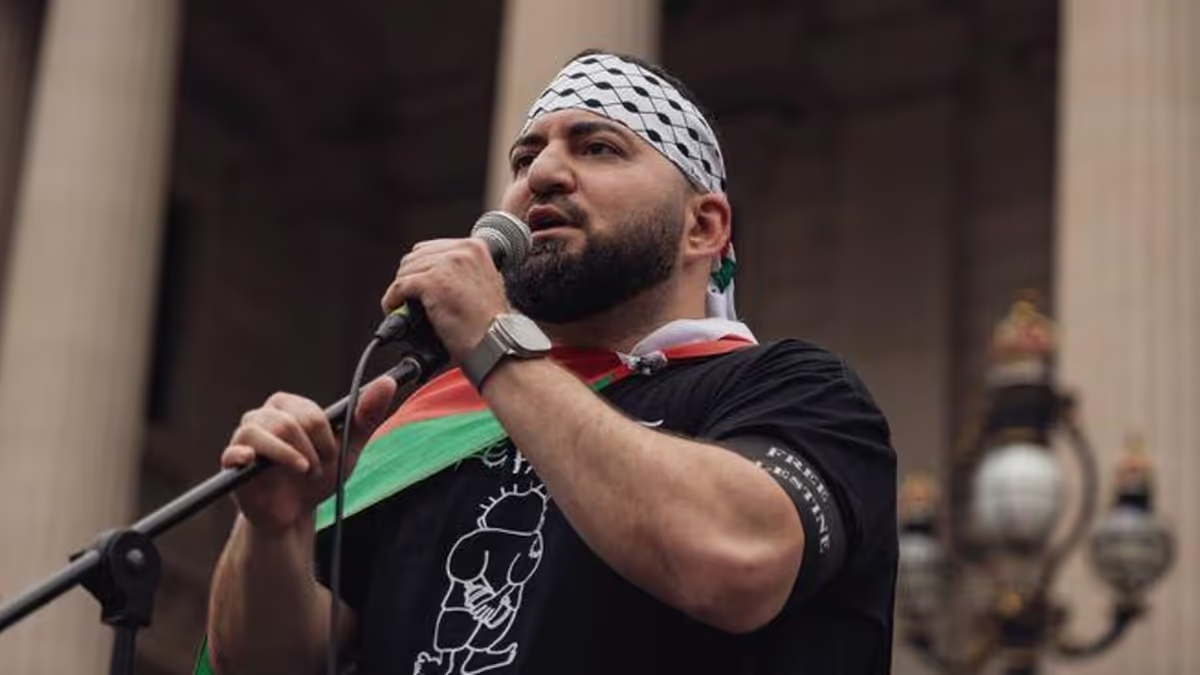
VCAT — the Victorian Civil and Administrative Tribunal, found that Hasheam Tayeh breached the Racial and Religious Tolerance Act 2001 (Vic) by initiating the chant “All Zionists are terrorists” at a pro-Palestinian rally.
The Tribunal accepted that “Zionist” does not literally mean “Jew,” but concluded that, in the context of the rally, there was a strong association between Zionists and Jewish people in the minds of ordinary participants. It held that the chant was likely to incite hatred against Jewish people on the grounds of race or religion.
VCAT did not accept Tayeh’s defence that the chant was protected political protest made in the public interest, finding it was not engaged in reasonably or in good faith under section 11 of the Act.
There are aspects of this judgment that warrant serious analysis. The Tribunal’s concern about antisemitic harm is understandable, but the reasoning it adopts sits uneasily alongside the more restrained approach to political speech reflected in Wertheim v Haddad [2025]. While the statutory frameworks differ, Haddad being decided under section 18C of the Racial Discrimination Act 1975 (Cth) and Tayeh under the Racial and Religious Tolerance Act 2001 (Vic), Haddad illustrates a judicial posture that insists on maintaining a clear distinction between ideological criticism and racial hostility, and resists collapsing criticism of Zionism into discrimination against Jewish people. By contrast, the decision in Tayeh places substantial weight on associative overlap between Zionism and Jewish identity, as well as on the broader rally atmosphere, to interpret the chant. If association and context become sufficient to bridge ideology and identity, the boundary protecting political protest narrows significantly. That divergence warrants careful scrutiny, not only in this case but also in the future treatment of protest speech more broadly.
These choices in reasoning need careful examination, especially because they could affect how political protest speech is treated in future cases.
1. The Association Leap
The Tribunal repeatedly acknowledges a crucial premise:
“Zionist does not mean Jew.”
That matters because the chant did not say “All Jews are terrorists.” It referred to “Zionists.”
But the Tribunal then reasons as follows:
- There was likely a “very strong association” between Zionists and Jewish people in the minds of ordinary rally participants.
- Most Jewish people identify as Zionist.
- Holocaust imagery and antisemitic tropes present at the rally strengthened that association.
- Therefore, the natural and ordinary effect of the chant was to incite hatred against Jewish people.
This is where the concern arises, at the threshold.
If a term does not mean “Jew,” and not all Jews are Zionists, at what point does a strong association become enough to treat criticism of an ideology as hatred of a race? The judgment does not clearly explain where the line is drawn. How strong must the association be? How widespread must the identification be? At what point does association become legal equivalence?
Without a clear limit, the distinction between criticising an ideology and attacking a people becomes harder to maintain.
2. Constructing the “Ordinary Audience”
The statutory test requires examining the “natural and ordinary effect” of the conduct on ordinary rally participants.
The Tribunal emphasises that actual proof of hatred is unnecessary; the likelihood or tendency to incite is sufficient.
However, the judgment constructs a psychological model of the audience that is open to question.
It includes:
- Participants with pre-existing antisemitic views.
- Individuals exposed to Holocaust-themed placards.
- Participants presumed to have been influenced by emotionally charged humanitarian narratives.
- Attendees assumed to hold a strong cognitive association between Zionism and Jewish identity.
The Tribunal accepts that the rally crowd was diverse. Not everyone there held extreme views. Not everyone carried inflammatory signs. Yet in analysing the chant, the decision places heavy weight on the most hostile elements present, antisemitic placards, Holocaust imagery, and abusive chants from others.
Those surrounding features become part of how the Tribunal interprets Tayeh’s words. That raises an important question: Was the chant unlawful because of what it actually said? Or because of the most extreme things happening around it?
If the legal judgment depends heavily on the angriest signs or the most aggressive voices in the crowd, then the speaker is no longer being assessed only on their own words. Their liability becomes intertwined with the overall atmosphere of the rally.
In practical terms, that blurs the line between individual speech and crowd behaviour. And that matters, because it means the legality of speech may depend as much on the surrounding mood as on the words themselves.
3. The meaning of the word “All” in “All Zionists are terrorists”
The Tribunal places strong weight on the word “all.” It says that using “all” removes individual differences and treats a whole group as the same, something often linked to racism. In other words, it suggests that saying “All Zionists” ignores nuance and paints everyone with the same brush.
The judgment treats the word “all” as a sign of racial stereotyping. But it does not clearly explain why saying “all” about a political group automatically becomes racial, especially when the group being described is an ideology, not a race.
If courts treat an association as enough to turn criticism of an ideology into criticism of a people, then any political movement that is closely linked with a community could trigger the same reasoning. The judgment does not clearly explain where that reasoning stops.
4. Political Ideology and the Absence of a Safe Harbour
The Tribunal is correct on this narrow legal point that the law does not give special protection just because speech targets a political belief. There is no automatic defence simply because something is political. But the decision does not fully deal with the bigger issue. When does criticism of a political ideology become criticism of a racial or religious group?
The key legal question should be simple: Was the chant directed at Jewish people as Jews, or at individuals because of their political beliefs?
Instead of focusing mainly on the exact meaning of the words used, the Tribunal focused on how the audience might have understood them. In other words, it looked less at what was actually said and more at what people might have associated or inferred from it.
That shift matters because it expands the reach of the law by holding that speech can become unlawful not just for what it clearly says, but also for what others might associate with it in their minds.
5. “Tipping Over the Threshold”
One of the most important parts of the decision says the chant would “tip many rally participants over the threshold into hatred directed towards Jewish people.”
That wording suggests that some hostility may already have been there, and that the chant pushed it further or made it feel normal.
The Tribunal says that “incite” does not just mean creating hatred from nothing. It can also mean stirring up feelings that already exist. That reading fits within the wording of the law. But it also widens the scope of liability. It means someone can be responsible not only for creating hatred, but for strengthening or encouraging it.
The practical effect is this: speech given in an already tense or divided setting may be judged more harshly than the same words spoken in a calmer environment. In that way, the mood of the crowd becomes part of the legal test.
6. Compression of the Section 11 Defence
The Tribunal dismisses the “public interest” and “good faith” defence fairly quickly. It says the chant went beyond protesting events after October 7 and was therefore not reasonable or made in good faith.
But given how serious a finding under sections 7 and 8 is, the discussion of this defence is relatively brief. The judgment does not look closely at some important questions, such as:
- Can strong or exaggerated political language still be made in good faith?
- Do protest slogans have to be toned down to stay within the law?
- Was there a careful balance between the speech involved and the legal consequences?
Because this part of the reasoning is short, it warrants further examination.
7. The Absence of a Limiting Principle
The biggest structural concern is that the decision does not clearly draw a line. Under the approach taken in this case, speech may become unlawful if:
- A political ideology is closely linked to a particular ethnic group,
- Strong, sweeping language is used,
- The surrounding environment is heated or inflammatory, and
- The audience is seen as likely to connect the ideology with that group.
If all of that is present, criticism of a political movement can end up being treated as racial incitement. The problem is that the judgment does not explain how strong that link must be, how many people must identify with the ideology, or what level of evidence is required before that leap can be made. Without clear limits, this reasoning could stretch the law further into the area of intense political protest.
Conclusion
Vorchheimer v Tayeh considers a legal question arising from political protest. The Tribunal makes it clear that concerns about antisemitic harm are real and serious. But the legal approach it takes raises important questions and concerns.
When strong association is treated almost like proof of identity, when courts focus more on how an audience might interpret words than on what the words clearly say, and when the mood of a protest affects how speech is judged, the line between political criticism and racial incitement becomes less clear.
In a diverse democracy like Australia, it is important to keep a careful balance. The law must prevent genuine racial hatred, but it must also protect strong, even harsh, political speech. How this decision is understood and applied in future cases may influence that balance for years to come.