The Limits of a Royal Commission on Antisemitism and Social Cohesion

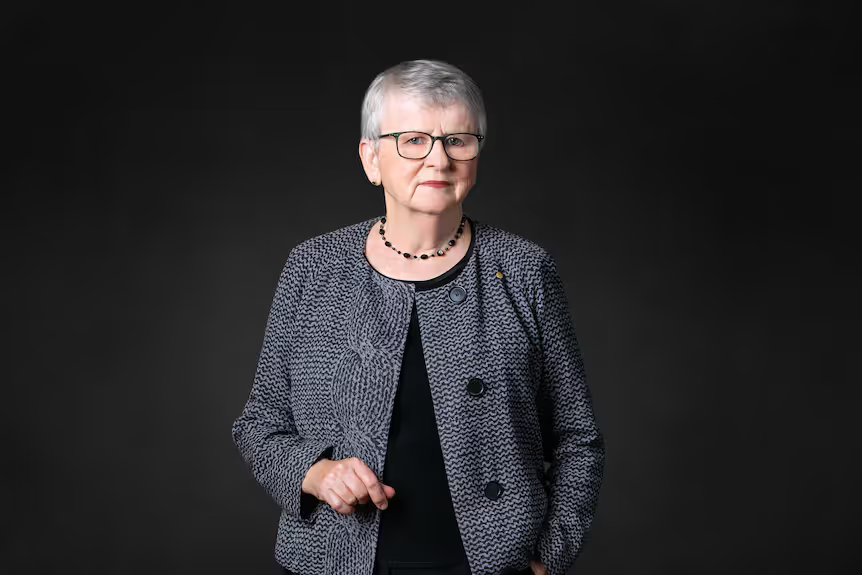
Commissioner Virginia Bell has formally opened the Royal Commission on antisemitism and social cohesion for public submissions, marking the beginning of the inquiry’s evidence-gathering phase.
Bell has indicated that while antisemitism would be the central focus of the Royal Commission, broader prejudice affecting other religions, ethnicities and communities could be considered as part of the inquiry into social cohesion. That distinction matters because it means antisemitism sits at the centre of the Commission’s investigative mandate, while other forms of racism are addressed only in a wider discussion about cohesion.
The issue raised here is not whether the Royal Commission will change its terms of reference. Those have already been set. The issue is how the scope of the inquiry shapes the evidence that will be gathered and the conclusions that will follow.
A Royal Commission is the most powerful public inquiry a country can establish. It determines which harms are investigated with the full authority of the state and which experiences remain peripheral to that process. Australia’s Royal Commission on antisemitism and social cohesion now carries that responsibility, yet Islamophobia and anti-Palestinian racism do not sit at the centre of its mandate. The result is that a significant part of the racism currently being experienced in Australia sits outside the main structure of investigation.
The missing part of the national story
A narrow mandate has practical consequences. It changes what the government will see and what it will miss. If a Jewish school needs protection, that can become part of the national record. If a Muslim woman is abused in public because she wears hijab, that is not automatically part of the same record. If a Palestinian student is punished for wearing a keffiyeh, that does not sit naturally inside this commission’s design. If a worker loses a job opportunity or a student faces disciplinary action because Palestine advocacy is treated as suspect or threatening, that falls outside the main machinery of this inquiry. The result is not simply an incomplete conversation. It produces an incomplete evidentiary record of how racism is functioning in Australia right now.
Social cohesion cannot be built by asking one community to trust a process that does not fully examine the forms of racism affecting that community.
This is exactly why concern has emerged beyond activist circles. Labor MP Ed Husic has said the royal commission should also examine Islamophobia and warned that “we now have a royal commission that won’t look at Islamophobia.” He also made the deeper point that if people believe the law or public institutions “cordon off protection to some groups and not others”, that damages confidence. That observation goes to the heart of the problem. Social cohesion cannot be built by asking one community to trust a process that does not fully examine the forms of racism affecting that community.
Why this matters for TMV and for the public
The Muslim Vote raises this issue because public institutions shape political reality. A Royal Commission does more than gather evidence. It tells the country what the state considers serious enough to investigate at the highest level. It influences future law, policing, education policy, public funding, and media language. If Islamophobia and anti-Palestinian racism remain outside the main terms of reference, the likely outcome is that policy will be built from a partial diagnosis. That has a cost. Communities experiencing anti-Muslim abuse, anti-Palestinian discrimination, surveillance, professional penalties, or public hostility will see that their experiences are acknowledged in speeches and side statements, but not examined with the same force, structure, and legal authority.
That cost is political as well as social. When people conclude that some harms trigger a full national response and others trigger deferral, community trust erodes. People stop expecting fairness from institutions. They begin to treat official language about cohesion as selective, because the practical protections do not reach them equally. That is not an abstract concern. The Human Rights Commission has already said that anti-Palestinian racism and Islamophobia are present in Australia and unacceptable, and that many affected communities feel their experiences are not adequately acknowledged or validated. Once that is the lived reality, a commission with a narrower mandate risks reinforcing the very distrust it claims to address.
Why this question matters
Royal Commission creates the official story that a country tells itself about a national problem. If that story is missing Islamophobia and anti-Palestinian racism, the final recommendations will rest on an incomplete account of what is happening in Australia. The issue here is straightforward. A commission established in the name of social cohesion cannot produce a full answer while leaving major forms of racism outside its central mandate. The public should not accept a national inquiry that examines hatred in fragments when the damage is being experienced across multiple communities at once. TMV raises this issue because decisions of this scale should not be allowed to settle quietly into the system without scrutiny. If the country is serious about social cohesion, then the inquiry must be serious about the full reality of racism in Australia.
TMV involvement in the Royal Commission
The Muslim Vote will participate actively in this Royal Commission process. A detailed submission will be prepared that documents instances of Islamophobia and anti-Palestinian racism experienced across Australian communities, drawing on testimony, documented incidents, and analysis of recent public and institutional responses. Where the Commission invites further engagement, The Muslim Vote will provide additional responses and evidence to ensure that these experiences form part of the record placed before the inquiry.
We are also on Substack
Follow us on Instagram