TMV Fortnightly Roundup

These last few weeks have been significant across legal, political and community fronts. Below is a breakdown of the key developments and our full analyses.
TMV Statement on the US/Israel Attack on Iran
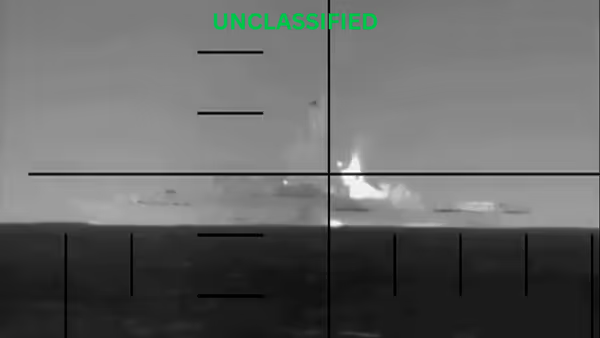
TMV issued a forceful statement condemning the expansion of Israel’s war from Gaza into sovereign Iranian territory, following joint US/Israeli strikes that included the bombing of a girls’ school in Minab where scores of young students were killed. The statement argued that Gaza had already shattered the credibility of international law, and that extending military force into Iran confirms that powerful states are prepared to override the prohibition on cross-border aggression when it suits their strategic interests. TMV rejected claims that the campaign serves the Iranian people, pointing instead to longstanding geopolitical calculations tied to regional dominance and resource control. The language of protection, the statement made clear, cannot obscure the human cost of escalation.
The statement also directly criticised Prime Minister Anthony Albanese’s support for the strikes, arguing that one cannot invoke a “rules-based order” while endorsing its breach. TMV situated the escalation within a broader pattern of Western intervention in the Middle East, from Iraq to Afghanistan to Gaza, where millions have been killed or displaced under the banner of security. It further noted Australia’s operational entanglement through Pine Gap, highlighting that intelligence infrastructure on Australian soil feeds into U.S. military operations. TMV concluded by calling on the Australian government to reckon with the consequences of the foreign policy tradition it continues to align itself with and to break from a trajectory defined by repeated devastation across the region.
The New Permanent Task Force
A 250-officer permanent armed unit will operate 24/7 around protests and places of worship. We examine the scope, framing and timing of this expansion, and what it signals for protest rights and state power.
The architecture of the policy is revealing: rapid response capability, long-arm rifles, permanent deployment, and simultaneous expansion of “multicultural liaison.” The framing is universal safety. The structure, however, intersects most directly with visible civic mobilisation. When armed presence becomes normalised in political space, the threshold for exceptional force shifts quietly but permanently.
Chris Minns’ Ramadan Letter to the Muslim Community
The Premier’s Ramadan message arrives on the back of consecutive decisions that have negatively impacted the general NSW communities. We examine the tone, timing, and political context, and what they signal about the government’s current posture toward Muslim communities.
Special Powers Granted to NSW Police for the Visit of Isaac Herzog
In the lead-up to the visit of Israeli President Isaac Herzog, NSW Police were granted expanded operational powers, including tightened protest controls and heightened enforcement capacity. These measures were justified on security grounds. However, their application on the ground raised serious concerns.
During protests opposing the visit, footage circulated of force being used against demonstrators, including the use of pepper spray and the removal of worshippers during prayer. These events are now the subject of scrutiny, including an ongoing investigation by the Law Enforcement Conduct Commission. The central question is not whether security should exist, but whether exceptional powers were proportionate to the conduct observed, and what precedent is set when political protest is managed through escalation rather than facilitation.
The Precedent Chris Minns is leaving NSW
What happens when executive decisions are layered one upon another without institutional restraint? From protest policing to expanded security architecture, this piece examines the long-term precedent being set by Chris Minns and why it matters beyond the present moment.
This is not about a single announcement or incident. It is about the cumulative pattern: emergency-style legislation introduced on contested facts, aggressive Police Law Enforcement for protest, and the rapid normalisation of permanent armed presence around civic life. Precedents rarely feel dramatic in real time. They feel incremental. But once embedded, they recalibrate what future governments can justify as “ordinary.”
LECC Investigation into Police Conduct
The Law Enforcement Conduct Commission continues its investigation into police actions during the February protests, including the use of force against demonstrators and worshippers. We examine what this investigation means for accountability and public trust.
Royal Commission Day 1
The Royal Commission commenced this week. We provide a clear account of what occurred, what was stated, and the structural implications moving forward. Definitions, frameworks and early positioning matter, and Day 1 revealed much.
The opening signals were telling. The application of definitional frameworks, the treatment of competing forms of racism, and the procedural direction of the inquiry will shape its eventual conclusions. Royal Commissions are not neutral arenas; they are structured processes. What is prioritised on Day 1 often determines what becomes marginal by Day 30.
TMV Calls for AFP Investigation
TMV has formally called on the Australian Federal Police to investigate and, if appropriate, take action regarding allegations of international law breaches involving Israeli President Isaac Herzog and senior Israeli military figure Doron Almog. The call is grounded in publicly documented statements and international legal proceedings currently underway in other jurisdictions.
This position reflects a consistent principle: accountability under the law must apply universally. Where credible allegations of grave breaches of international law arise, they should be assessed through proper legal channels, regardless of political office or nationality.
The Hasheam Tayeh Decision
VCAT ruled that leading the chant “All Zionists are terrorists” breached Victorian vilification law. We unpack the reasoning, examine the association logic relied upon by the Tribunal, and assess the broader implications for political protest speech.
The critical move in the judgment was not semantic but associative. The Tribunal accepted that “Zionist” does not mean “Jew,” yet concluded that strong audience association was sufficient to ground liability. That reasoning raises deeper questions about when criticism of an ideology becomes, in law, hostility toward a people. The absence of a clear limiting principle is what makes this case consequential.
At a time when police powers are expanding and legal boundaries around protest are evolving, these developments are not isolated. They form part of a broader trajectory that deserves careful scrutiny.
As always, TMV remains committed to principled analysis grounded in law, accountability and long-term community impact.
Follow us on Instagram