Why The Muslim Vote Made Submissions on the NSW and Federal Hate Laws.
Over the past year, governments at both the state and federal levels have moved to expand hate and extremism laws in ways that fundamentally reshape the relationship between speech, belief, and state power. These changes have largely been framed as technical adjustments, necessary updates to protect social cohesion, public safety, and vulnerable communities.
We did not accept that framing.
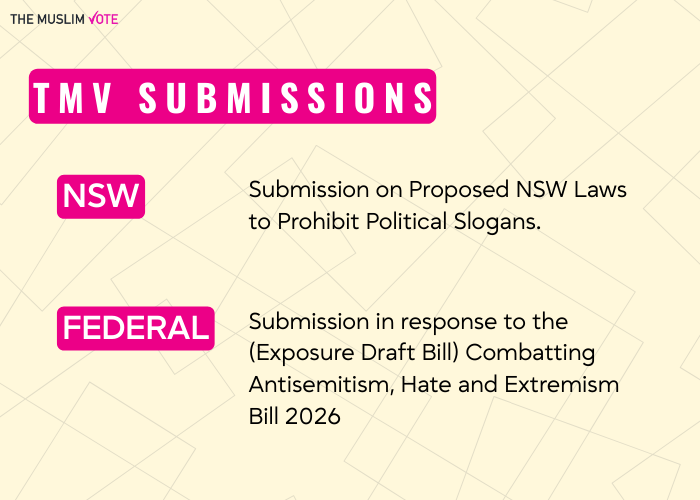
This is why we prepared and lodged detailed submissions on both the NSW hate laws (NSW Submission) and the proposed federal antisemitism, hate, and extremism Bill (Federal Submission). This was not a symbolic gesture or an exercise in box-ticking; rather, these laws raise serious questions about how power is exercised, who bears the risk of expanded discretion, and which communities are most likely to feel the consequences long after public attention moves on.
What these submissions were really about
At their core, our submissions were not arguments against protecting people from harm. They were arguments against lowering legal thresholds in ways that detach punishment from actual harm, intent, or causation.
Both the NSW and federal proposals shift the legal focus away from demonstrable outcomes and toward speculative assessments made after the fact, assessments shaped by political pressure, media narratives, and institutional bias. When the law begins to punish perceived risk rather than actual conduct, it creates a system where meaning, context, and intent become liabilities rather than safeguards.
This shift matters because history shows that broad, ambiguous powers are not applied evenly. They are applied where resistance is weakest, where communities are already under suspicion, and where dissent can be reframed as danger.
Why Muslim communities cannot treat this as abstract
For Muslim communities in Australia, these laws do not arrive in a vacuum. They arrive after decades of securitisation, intelligence-led engagement, and policy frameworks that have already blurred the line between belief, identity, and threat.
Our concern is not hypothetical. It is grounded in lived experience. A government that refuses to name genocide, continues to arm Israel, advances expansive laws on the basis of security events it knows were false, and then extends diplomatic legitimacy by inviting Isaac Herzog even after Israeli authorities themselves have acknowledged civilian deaths exceeding 80,000, is not operating in uncertainty. Submissions matter precisely because they force governments to defend these decisions on the public record, where inconsistencies between stated commitments to law, accountability, and human life cannot be managed quietly or resolved through internal assurances.
Why we are publishing this now
We are publishing this not because the submission process is complete, but because the consequences are ongoing. Laws like these do not reveal their full impact immediately. They unfold over time, through enforcement patterns, selective prosecution, and the quiet reshaping of what people feel safe to say, teach, or question. This platform exists to track that unfolding honestly.