The Interim Report by the Royal Commission Pulls Palestine Protest Into a Security Frame
The interim report by the Royal Commission frames social cohesion as a security project.

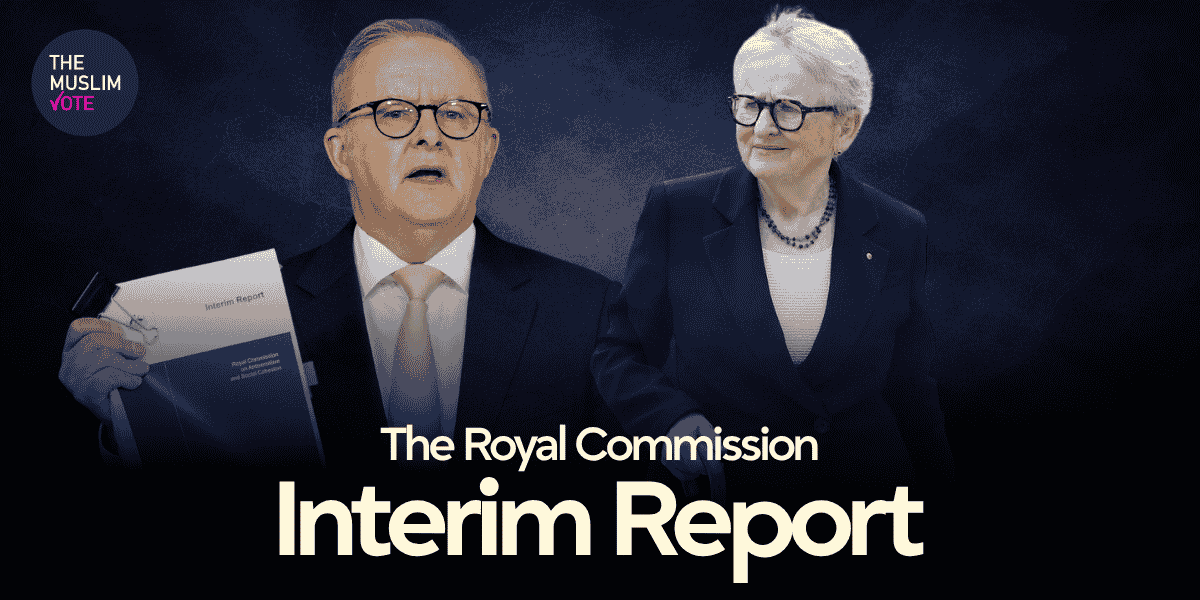
The Interim Report released by the Royal Commission contains 14 recommendations, several of which remain confidential. The report builds a frame in which Jewish communal protection is formalised through policing, intelligence and protective-security architecture, while Palestinian protest is pulled into a security framework, and Muslim and Palestinian communities are left largely outside the report’s concern unless they appear as part of the problem.
Protests placed inside a security framework
The interim report by the Royal Commission places pro-Palestine protests, public mobilisation and anger over Gaza inside a security narrative, then allows that narrative to sit beside counter-terrorism, antisemitism, radicalisation and law enforcement failure. The report repeatedly ties the Palestinian protest environment to a rise in antisemitism, then reproduces ASIO language that the “normalisation of violent protest” lowered the threshold for more provocative and violent acts, and that narratives centred on “freeing Palestine” expanded to incitements to “kill the Jews.” It also says the ongoing Middle East "conflict" remains a key driver of violent protest activity.
That is a serious framing move because it places anti-genocide and pro-Palestine protests inside a security narrative that can later justify more surveillance, more regulation, and more suspicion.
The report cites ASIO material saying there was “no credible information to indicate planned violent protest targeting crowded-places events”, but then also says the "Middle East conflict" remains a “key driver of violent protest activity.” The report simultaneously denies specific planned violent protest while maintaining a generalised suspicion around Palestine-related protest, claiming that the Middle East conflict drives violent protest activity.
No urgent legal gap was identified
One fact should sit at the centre of this debate: the report states that no Commonwealth or state intelligence or law enforcement agency identified a gap in existing legal or regulatory frameworks that prevented authorities from preventing or responding to an attack like Bondi.
That admission is significant. If the law were not the barrier, then the answer cannot be more suspicion, more speech regulation, or more policing of Palestinian protests. This point undercuts any attempt to use the interim report as a mandate for new speech laws, protest restrictions, slogan policing, or expanded surveillance of Palestine advocacy.
The report erases the cause of protest, then treats protest as the problem
The report’s failure is that it separates pro-Palestine protests from the mass civilian harm that produced it, then places that protest inside a security narrative. Bondi requires evidence about the alleged perpetrators, their motives, their planning, and their conduct. The protests, however, were based on opposing mass civilians death and genocide. This conflation was a deliberate attempt to reframe the narrative. Palestinians, Muslims, and many other Australians did not march because of the abstraction. They marched because they were watching Gaza destroyed in real time: families killed, children buried, hospitals attacked, people starved, and political leaders refusing to act.
When the report speaks at length about antisemitism, protest activity, violent protest, radicalisation and security risk, while refusing to give serious analytical weight to genocide as the driver of public mobilisation, it performs a serious distortion. It takes a movement protesting mass civilian killing and places it in the same narrative field as Bondi, terrorism and antisemitic threat. That conflation must be rejected. People marched seeking an end to the killings in Gaza. To detach that mobilisation from its cause, then allow it to sit beside the language of radicalisation and violent threat, is to recast protest against genocide as a security problem. That is precisely the narrative Israel and its defenders have pushed: that opposition to genocide is not a moral response to mass civilian harm, but a form of extremism, disorder or antisemitic hostility. A Royal Commission concerned with social cohesion should not reproduce that frame; it must interrogate it.
Muslim-Coded Counter-Terror Assumptions
While the report does not explicitly say terrorism is Muslim-based, it structurally reproduces that notion. Chapter 6 walks through Australia’s counter-terror history via 9/11, Bali, Lindt, ISIL, al-Qa’ida, and the 2017 intelligence review’s concern with “Islamist terrorism” and “others that claim to act in the name of Islam.” Then, when the report overlays present "concerns" about Gaza, protest, and antisemitism onto that same machinery, the effect is clear: Muslim-coded counter-terror frameworks remain the background grammar of the report.
Specific institutional recognition
If this is a report on social cohesion, why is only one community’s harm given specific institutional recognition while others are left unnamed? The issue is not that Jewish support services are listed (i.e. Jewish House and JewishCare). The issue is that the report claims to be about antisemitism and social cohesion, yet its support architecture signals a hierarchy of recognition before the argument even begins. Jewish trauma is named specifically, and Jewish support is given its own category. But communities affected by the genocide of Gaza, Islamophobia, anti-Palestinian racism, and collective suspicion are folded into broad generic categories such as “Multicultural & Anti-Discrimination Support.”
The report gives CSG (Community Security Group) a dedicated chapter and institutional legitimacy
The interim report gives CSG a dedicated chapter and institutional legitimacy. It presents CSG as a central communal security body with regular engagement with police and intelligence agencies, and it normalises its role in threat assessment, event planning and police liaison. That alone raises serious questions about transparency and accountability, particularly around an organisation with clear links to Israel and IDF soldiers. Public reporting that an ADF officer who volunteered with Sydney CSG described CSG training as a “natural recruiting pool” for Mossad, while SBS reported that the same officer undertook Israel-based security, self-defence and firearms training connected to his CSG role, organised by Ami-Ad and funded by the Israeli government. CSG was effectively elevated into a quasi-security partner without scrutiny.
Evaluations
The report is paper-thin on the metric and evaluation problem. It invokes a “disturbing escalation” in antisemitic incidents and leans on operations such as SHELTER, PEARL and AVALITE, yet the public report does not grapple with the known and on-the-record problems around incident inflation, category mixing, or the broader instability of antisemitism metrics. The report notes the Dural caravan was a fabricated terrorism plot, but does not grapple with the political consequences of the alarm generated before that clarification.
Police Minister Yasmin Catley referred to more than 700 antisemitic events, incidents and arrests. NSW Police later confirmed a very different breakdown: 367 antisemitic entries, 38 Islamophobic entries and 410 “other” matters. Those “other” matters included protest activity, political statements involving no offence, matters outside Operation Shelter and duplicate entries. NSW Police also acknowledged that a significant number of the 367 did not meet the criteria for antisemitism and that consistency and veracity in recording varied over time.
Social cohesion framed as a security project
The report narrows social cohesion into a security project. In practice, the interim report treats cohesion as stronger counter-terror coordination, more protective security, more intelligence integration, and more firearms reform. Those may be relevant to Bondi, but they are not a complete account of cohesion. There is almost nothing in the public recommendations about equal standards across communities, protest rights, Islamophobia, anti-Palestinian racism, collective attribution, or the dangers of collapsing dissent into extremism. The recommendations are overwhelmingly machinery-of-state recommendations.
The silence is the conclusion
The report acknowledges that Operation SHELTER was created in response to antisemitic and Islamophobic incidents, but Islamophobia never becomes a real analytic category. Anti-Palestinian racism does not become a structural concern. Palestinian grief and advocacy are not treated as part of the cohesion process. Protest appears more readily as risk than as democratic participation. The dehumanisation of Palestinians and Muslims is not addressed. That silence will be read by communities exactly as one would expect.
The report’s recommendations are overwhelmingly about:
- Jewish event security,
- counter-terror coordination,
- ANZCTC (Australia-New Zealand Counter-Terrorism Committee) processes,
- JCTT (Joint Counter Terrorism Team)
- firearms reform,
- information sharing.
Its recommendations move toward machinery: counter-terror coordination, JCTT review, intelligence and information-sharing systems, firearms regulation and protective security. What is absent is equally revealing: no substantive framework for Islamophobia, anti-Palestinian racism, protest rights, equal institutional recognition or safeguards against treating Palestine advocacy as extremism.