We've Lodged Our Submission to the Royal Commission
A robust submission that addresses key issues.

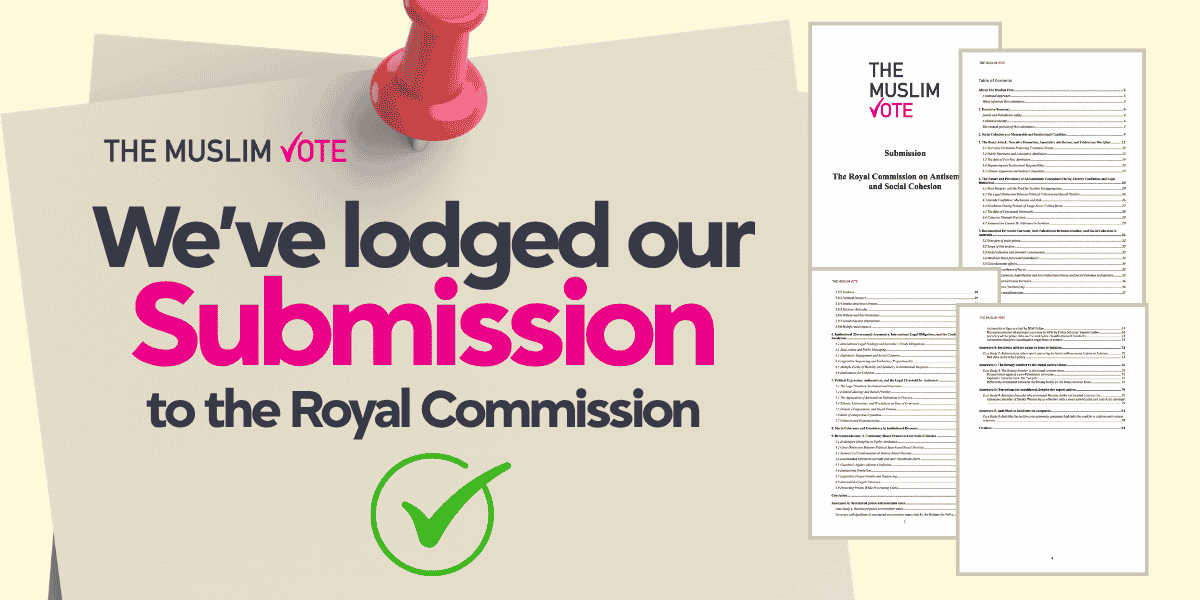
The Muslim Vote has made a formal submission to the Royal Commission on Antisemitism and Social Cohesion, calling for a principled, evidence-based and consistent approach to public safety, racism and community trust.
A central argument of our submission is that social cohesion cannot be built through a hierarchy of concern. Any credible anti-racism framework must recognise the harms experienced by First Nations people, Jewish Australians, Palestinian Australians, Muslim Australians, Arab Australians and other communities, while applying one consistent standard of dignity, safety and protection. These harms are not external to social cohesion. They shape whether communities feel safe, whether they trust institutions, whether they participate openly in public life, and whether they believe protection is applied equally.
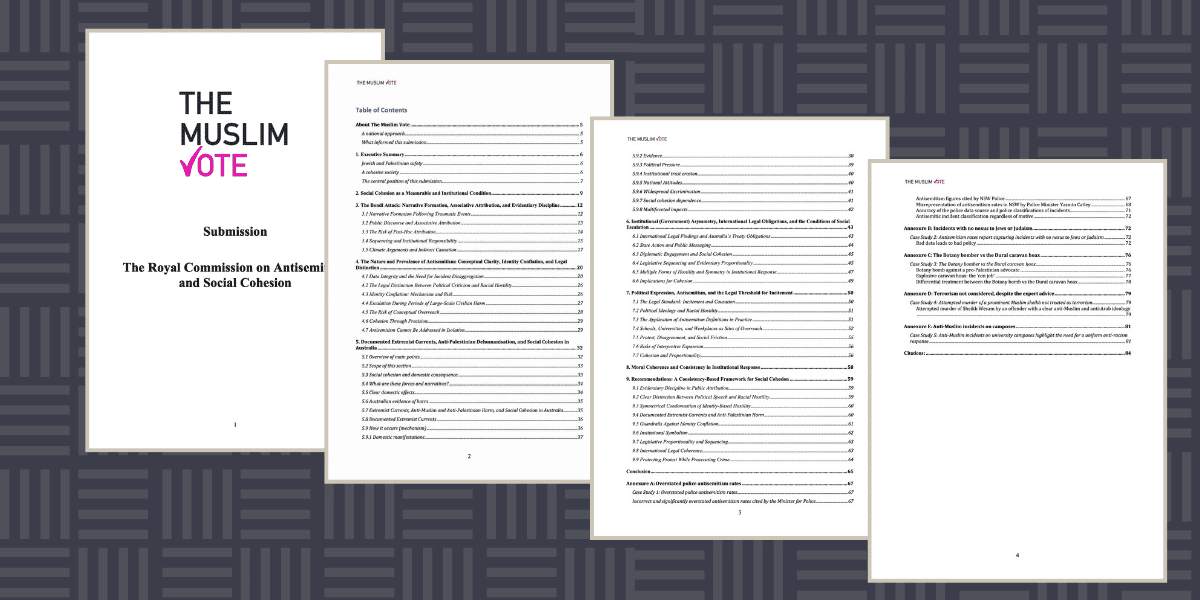
The submission also addresses how extremist and dehumanising narratives against Muslims and Palestinians travel across borders and take domestic form in Australia. These narratives can frame Palestinians as inherently violent, Muslims as security threats, and Palestine advocacy as extremism. When such ideas are repeated in the media, politics, institutions, or public conduct, they contribute to suspicion, exclusion, and unequal treatment.
We also addressed:
• Climate-based causation is dangerous when it replaces proof.
In other words, an “atmosphere” argument must not become a shortcut for casting blame against an entire community or for restricting lawful political expression. This allows governments or institutions to blame a broad social mood, protest environment or political atmosphere without proving a direct connection to violence or unlawful conduct.
• Analysis of violent extremism should be evidence-based and not be explained through simplistic ideology-first models.
The submission argues that violent extremism is shaped by multiple factors, including isolation, grievance, alienation, psychological deterioration, family dynamics, fixation, and behavioural escalation. The literature does not argue that faith is a root cause of violent extremism.
• Criticism of Israel or Zionism must not be deemed antisemitism.
The submission relies on the distinction between criticism of Israel and racial hostility. Criticism of Israel for its mass killing of civilians is not antisemitic.
• Extremist and dehumanising currents against Muslims and Palestinians can be transnational or manifest domestically.
The submission argues that narratives framing Palestinians as violent, Muslims as security threats, or Palestine advocacy as extremism can travel across borders and take local form in Australia.
• Lawful political expression must be protected.
Speech should not be restricted merely because it is controversial, offensive, visible or unsettling.
• Recommendations should be evidence-based, proportionate and equal across communities.
The submission asks for consistent standards across antisemitism, anti-Muslim, anti-Palestinian racism, anti-Arab hostility and other identity-based harms.